Implanted port (port-a-cath)
A central line buried entirely under the skin. You access it only with a non-coring (Huber) needle and strict asepsis - and only if trained. The disc is the clue.
Also called: port, port-a-cath, portacath, implanted port, subcutaneous port, PAC, chemo port
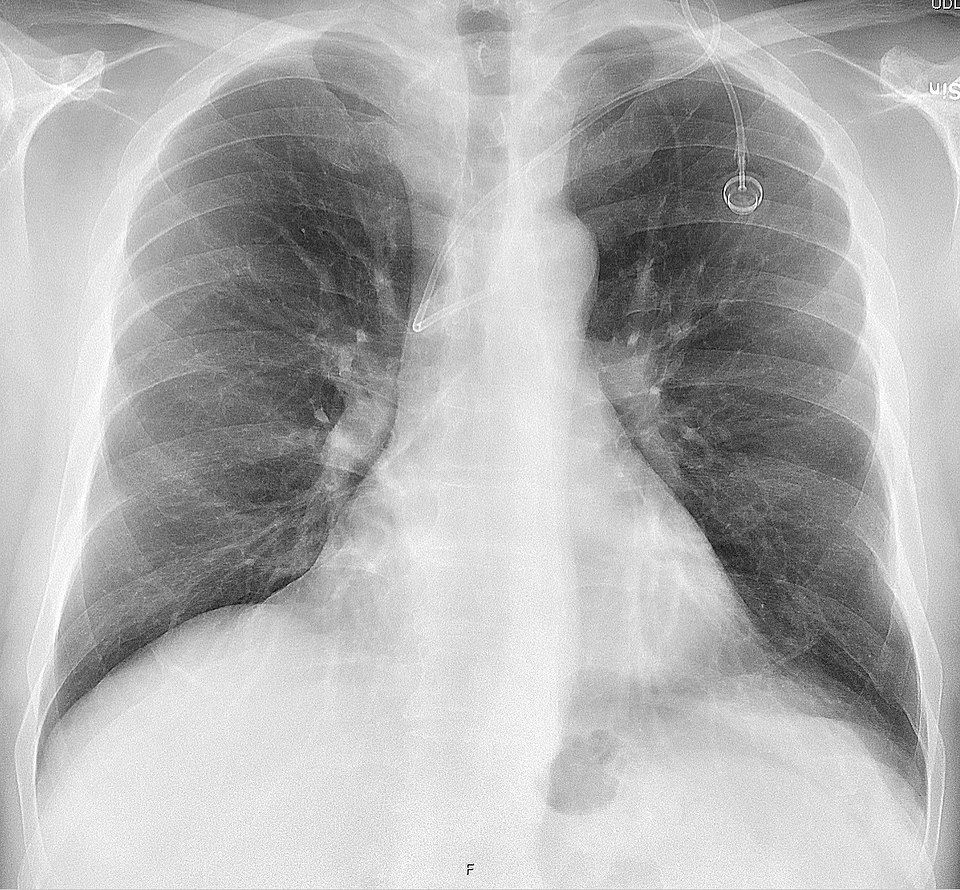

What it is
An implanted port is a central venous device with nothing outside the body: a small reservoir (the port) sits under the skin, usually on the upper chest, connected to a catheter whose tip lies in a central vein. It is accessed by pushing a special non-coring (Huber) needle through the skin into the port's silicone septum. Like the tunnelled line, epic3 lists it among the devices for patients in whom long-term vascular access is required
.
Because nothing crosses the skin between uses it carries a low infection risk among the long-term devices, and is invisible until you feel the disc. The ED issues are infection (port-pocket or bloodstream), accessing it safely, and knowing when you may not access it. Used in adults and children (paediatric oncology).
How to recognise it
- A firm disc (often with a raised centre) palpable under the skin of the upper chest, with a small scar and no catheter exiting the body.
- A patient on or recently finished chemotherapy, carrying a port card with the device type and needle size.
- If currently accessed, a Huber needle and dressing over the disc with a short extension and clamp.
What it gets confused with
A Hickman has an external catheter you can see exiting the chest; a port has nothing external - just a disc under intact skin. If you can see a catheter, it is not a port.
What goes wrong
Port or bloodstream infection
Fever or rigors (classically when the port is used), or a red, tender, sometimes fluctuant port pocket.
Red flag
Take cultures before antibiotics (peripheral, and from the port if it is accessed by someone competent), treat sepsis, and refer. A pocket infection or infected port often needs removal; that is the owning team's decision.
Difficult or failed access
The port will not aspirate or flush, or cannot be accessed - malposition, fibrin sheath, catheter fracture, or simply nobody trained to needle it.
Red flag
Do not keep jabbing. If the port cannot be accessed safely, obtain alternative access (peripheral or, in an emergency, intraosseous) and refer the port problem on.
Catheter fracture or pinch-off
Pain or swelling on flushing, inability to aspirate, or a fragment seen on imaging; rarely a fractured catheter can embolise.
Red flag
Stop using the port, image if suspected, and refer urgently - an embolised fragment needs retrieval.
The first ten minutes
- Treat the clinical problem and establish access you can actually use. Do not delay resuscitation to access a port - use a peripheral cannula or intraosseous route and sort the port out afterwards.
- Access the port only if trained, with a Huber needle and strict asepsis - a standard needle will core and damage the septum. epic3:
Use the aseptic technique for the insertion and care of an intravascular access device
, and decontaminate the hub for at least 15 seconds. - For suspected infection, cultures before antibiotics (from the port only if competently accessed), then sepsis treatment and referral.
- For a suspected fracture or embolised fragment, stop using the port, image, and refer urgently.
- Call the owning team (oncology or vascular access) about access problems and any decision to remove.
Do not
Who owns it
The oncology / haematology or vascular access team that placed and uses the port. Tell them whether it can be accessed, whether it flushes and aspirates, the local and systemic findings, and the culture results.
Who to call
The team and the criteria are national. The phone number is local, and this tool does not know it. Find it once, now, and write it on the department's own card — that is the part no website can do for you.
- Say the device name first
- Open with laryngectomy, LVAD, shunt — the single word changes who comes and what they bring. Do not bury it in the history.
- Say what you have already established
- Whether the device is patent, whether it has been removed or disturbed, and what you have already tried. The specialist is deciding whether to walk or run.
- Ask who owns it out of hours
- Device ownership and the on-call route often differ from the implanting specialty, and it is frequently a regional centre rather than your own hospital.
- The patient's own team is a resource, not an afterthought
- Named nurse specialists, home-care companies and device helplines answer questions nobody else can, and the patient usually has the number.
When the device is not the problem
A patient with a device gets pneumonia, sepsis, pulmonary oedema and myocardial infarction at the same rate as everybody else. The device is the most visible thing about them and it attracts the whole assessment.
- The NTSP says it out loud
- The project's own manual warns that
patients with tracheostomies can become unwell with all the problems that other patients get too. It is easy to become fixated with the tracheostomy.
The same sentence applies to every device in this tool. - Clear the device, then leave it
- Establish that the device is doing its job — the stoma is patent, the line draws back, the pump is running — and then assess the patient as you would anyone else.
- The anchoring runs both ways
- The opposite error is treating a device complication as a medical illness: a blocked gastrostomy read as vomiting, a baclofen pump failure read as sepsis.
- NTSP manual — Red flags · read in full
What the patient will be carrying
Patients carry a port identification card with the device type and the correct Huber needle length, and the owning team's contact. It tells you how to access the port safely.
Scope of this page
This page covers recognising an implanted port and the safe first response: use another route in an emergency, access the port only if trained and with a Huber needle, culture and treat infection, and refer. It does not teach port implantation, de-clotting, or the removal decision, which belong to the owning and vascular access teams. Used in adults and children; paediatric access and dosing are team-directed.