Pacemaker and ICD
The question that changes everything is whether the box can shock. A magnet does opposite things to a pacemaker and to an ICD - so find out which one it is first.
Also called: pacemaker, PPM, permanent pacemaker, ICD, implantable cardioverter defibrillator, AICD, defibrillator box, box, cardiac device, CIED
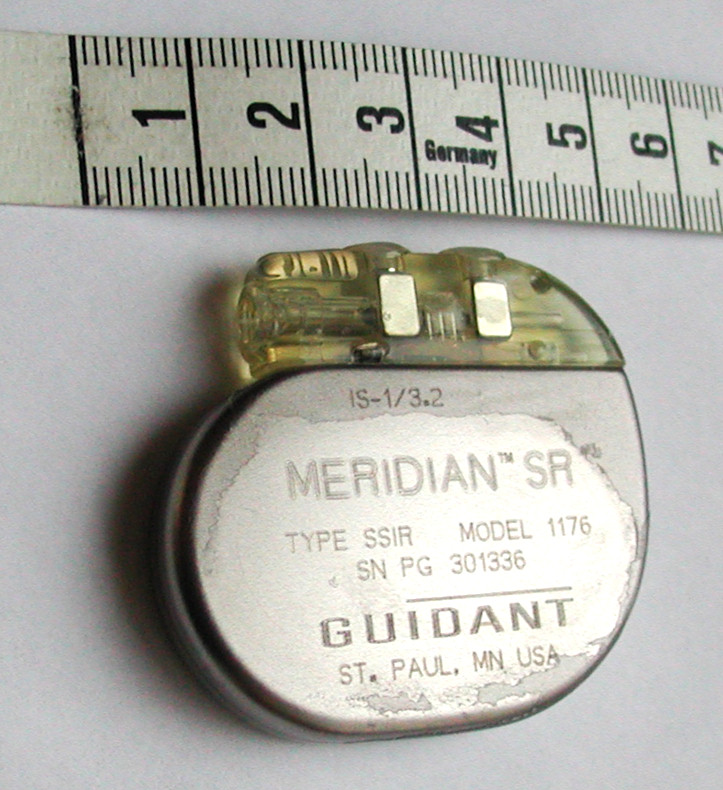

What it is
A pacemaker paces the heart when it goes too slow. An implantable cardioverter defibrillator (ICD) does that too, but its main job is to detect a life-threatening ventricular arrhythmia and treat it - with rapid pacing (ATP) or a shock. The UK guidance puts it plainly: ICDs are implanted to deliver a defibrillatory shock when the patient develops a ventricular arrhythmia that is an immediate threat to their life
, and in addition ICDs have a back-up pacemaker function
.
Both sit as a pectoral lump, usually left, with one to three transvenous leads. You cannot reliably tell a pacemaker from an ICD by looking - and the difference decides what a magnet does, what a shock means, and what has to happen before the body goes to the mortuary. Get the device identification card, or interrogate it. This page is written for adults, in whom these devices overwhelmingly sit; children do receive them, but their pacing indications and follow-up are a separate paediatric pathway.
How to recognise it
- A firm rectangular lump below a clavicle, usually the left, with a scar over it. An ICD is bigger than a pure pacemaker but you should not rely on size.
- The patient carries a device identification card naming the manufacturer, model and implant indication - the single most useful piece of paper, because the magnet response and the manufacturer-specific behaviour below depend on it.
- A subcutaneous ICD (S-ICD) generator sits in the left lateral chest wall, not the pectoral region, and has no transvenous lead - see the separate CRT and S-ICD entry.
- On a chest film: a generator with leads tracking into the heart. A shock coil (a thick radio-opaque segment on the lead) means the device is an ICD, not a plain pacemaker.
- A leadless pacemaker (e.g. Micra, Aveir) has no pectoral lump and no leads - the whole device sits inside the right ventricle and shows as a small capsule within the cardiac shadow on the film. A magnet has no effect on it.
- A small, flat device with no leads over the chest (not inside the heart shadow) is probably an implantable loop recorder, which only records - see that entry.
What it gets confused with
A CRT or subcutaneous ICD is a variant, not a different animal: a CRT-D and an S-ICD both shock; a CRT-P does not. The magnet rule is the same (magnet suspends shocks on any device that can shock; magnet does not deactivate pacing). The CRT/S-ICD entry covers only where they diverge from this page in a way that changes ED action.
An implantable loop recorder is a small leadless device that can be mistaken for a tiny pacemaker. It delivers no therapy, has no useful magnet response, and is almost never the cause of the emergency (rarely, its pocket can get infected or erode). If there are no leads on the film, think loop recorder - or, inside the heart shadow, a leadless pacemaker.
A neurostimulator (vagus nerve or spinal cord stimulator) can sit in the chest wall and, as the UK guidance warns, they may be mistaken for pacemakers
. It has nothing to do with the heart rhythm and must not be managed as a cardiac device.
What goes wrong
The ICD is delivering repeated shocks (electrical storm, or inappropriate shocks)
A conscious patient being shocked, sometimes repeatedly. It may be appropriate shocks for recurrent VT/VF (electrical storm) or inappropriate shocks triggered by AF, lead noise or a fractured lead in a patient who is haemodynamically fine.
Red flag
The ICD usually gives no warning before it delivers a shock
and will deliver a run of shocks - often up to 8, sometimes more
- restarting the sequence if the arrhythmia recurs. A conscious patient receiving repeated shocks needs urgent cardiology and, if the shocks are inappropriate or intolerable, emergency magnet suspension while you sort out why (see the magnet panel).
Failure to pace / failure to capture
Bradycardia or syncope in a pacing-dependent patient; the monitor may show pacing spikes with no following QRS (failure to capture) or no spikes at all (failure to output). Causes include lead displacement, battery depletion and electrolyte disturbance.
Red flag
Treat the bradycardia on its merits (ALS bradycardia algorithm, transcutaneous pacing if needed) and get a physiologist to interrogate urgently. An external pacemaker can be used, but if the implanted device is emitting spikes the external unit must be set faster than the programmed rate or out of demand mode, or its output will be inhibited.
The patient is in a shockable cardiac arrest
VF or pulseless VT. The ICD should shock, but may fail to, or its shocks may not terminate the rhythm.
Red flag
Do not wait for the box. The guidance is explicit: During cardiorespiratory arrest in a shockable rhythm, external defibrillation should be attempted in the usual way if the ICD has not delivered a shock, or if its shocks have failed to terminate the arrhythmia.
Run standard ALS, with pad placement as in the defibrillation panel.
The device is not the problem
Sepsis, PE, pulmonary oedema, bleeding, MI - a device patient gets all of these. The pectoral box draws the eye.
Red flag
Pocket or bloodstream infection tracking along the leads (device-related endocarditis) is the device-specific sepsis to keep in mind, but most illness in these patients is ordinary illness. Assess the whole patient.
The first ten minutes
- Is this a cardiac arrest? If so, standard ALS. No special precautions are needed for CPR: the guidance states
No special precautions are necessary when delivering chest compressions and/or ventilation in the presence of an implanted electronic device
, and a discharge felt by a rescueris believed to present no major risk to another person in contact with the patient
(gloves are advised anyway). - Place defibrillation pads clear of the box. Keep pads away from the generator and consider anterior-posterior placement - see the defibrillation panel for the distances.
- Conscious and being shocked? Get a 12-lead and a rhythm strip, treat reversible triggers (ischaemia, electrolytes, especially K+ and Mg2+), and call cardiology. If shocks are repeated and inappropriate or intolerable, a magnet suspends shock therapy while the device is interrogated - but first attach external defibrillator pads and continuous monitoring and confirm the rhythm, because a magnet removes the ICD's safety net: if the shocks are actually appropriate (VT/VF storm) you must be ready to defibrillate externally within seconds. See the magnet panel for exactly what a magnet does and does not do.
- Get the device identification card and call the cardiac physiology / device service. The manufacturer determines magnet behaviour (one brand restores shocks after 8 hours) and only interrogation tells you what the device has seen and done.
- Bradycardia or failure to pace? Treat the patient (ALS bradycardia algorithm), arrange urgent interrogation, and remember the external-pacing caveat above.
- After return of spontaneous circulation, arrange device interrogation: the guidance advises that
the device should be interrogated and checked (usually by a cardiac devices physiologist) at the earliest opportunity
, both to confirm it still works and to read the rhythm that caused the arrest.
Do not
will not deactivate it but will cause the pacemaker to fire at a faster than usual rateand stops it being inhibited by the patient's own beats. A magnet only suspends shocks on a device that can shock (an ICD). Know which device you have before you reach for a magnet - see the magnet panel.
removal or displacement of the magnet will immediately restore the ability of the ICD to deliver a shock. Tape it on and check it has stayed put. One manufacturer (Biotronik) restores shocks after 8 hours regardless, so with that or an unknown device the magnet must be lifted briefly and replaced. Definitive deactivation is a physiologist with a programmer.
should not be placed over or close to implanted electronic devices- it risks damaging the device and the myocardium at the lead tip. Move the pad, or go anterior-posterior.
must be deactivated before any attempt is made to remove them or to perform an autopsy, to avoid risk of a shock to the person carrying out that procedure. And every implanted generator must be removed before cremation because it
may explode when heated to a high temperature. This is a safety issue for mortuary and funeral staff, not just the patient.
Who owns it
Cardiology and the cardiac physiology (device) service own the box; the physiologist with the manufacturer's programmer is the person who can read and reprogramme it. When you call, give the device identification card details (manufacturer and model), say whether it is a pacemaker or an ICD, whether the patient is pacing-dependent, what the device has done (shocks delivered), and the current rhythm and potassium.
What a magnet does to each device
This is the single most-confused fact in the whole tool, and it is dangerous because the same magnet does opposite things depending on the device. The rule beneath the table: a magnet suspends shocks on anything that can shock (ICD, CRT-D, S-ICD) and does nothing to stop pacing on anything that only paces - on a pacemaker it forces fast, asynchronous pacing. Always identify the device from its card before reaching for a magnet. Two caveats: the magnet response is not universal - a leadless pacemaker (Micra/Aveir) has no magnet sensor and the response can be programmed off, so no magnet response does not prove the device is inactive; and these rules apply to a child with one of these devices too (paediatric pad size, energy and specialist advice are not covered here).
- ICD (including CRT-D, S-ICD)
- A magnet suspends shock therapy only while it is held in place - the guidance:
Placing a strong magnet on the skin over the ICD generator will suspend tachyarrhythmia detection (and thereby suspend shock delivery)
. It does not stop pacing. Tape it on and check it stays:removal or displacement of the magnet will immediately restore the ability of the ICD to deliver a shock
. One manufacturer (Biotronik) restores shocks after only 8 hours, so with that or an unknown device lift and replace the magnet periodically. Before applying the magnet for a shock storm, put external defibrillator pads on and get a rhythm strip - the magnet removes the safety net, so if the shocks are appropriate (VT/VF) you must be ready to defibrillate externally at once. - Pacemaker (and CRT-P)
- A magnet does NOT switch it off. It
will not deactivate it but will cause the pacemaker to fire at a faster than usual rate
and stops it being inhibited by the patient's own beats (asynchronous pacing). The guidance adds that magnetsshould not be used in a misguided attempt to deactivate
a pacemaker. The one time a pacemaker magnet helps: if the pacemaker is being wrongly inhibited by oversensing (surgical diathermy, myopotentials, lead noise) and the patient is bradycardic or pausing, holding a magnet on forces asynchronous pacing and restores a reliable rate. - On a device that both paces and shocks
- The magnet suspends the shock function only; pacing continues. The appendix states plainly:
Magnet application does NOT affect the programmed pacemaker function of the device.
So a magnet makes a pacing-dependent ICD patient no less paced - it only stops shocks. - Vagus nerve stimulator (VNS)
- Opposite logic to a cardiac magnet. Holding the magnet over the generator deactivates stimulation (
continuous application of the magnet to the generator will deactivate the device
); swiping it delivers an extra burst to abort a seizure. In an emergency without the patient's VNS magnet,any magnet with a strength over 50 gauss can be used to deactivate the device
. - Loop recorder
- Nothing to suspend - it delivers no therapy. A magnet is irrelevant to it.
- After death with an active ICD
- A magnet is only a temporary hold, not deactivation:
Temporary deactivation using a magnet is not adequate
before autopsy, device removal or cremation. A physiologist must deactivate the ICD, and if the patient has died with the magnet suspending shocks it must stay taped in place until they do. Note a brand that auto-reverts (e.g. Biotronik at 8 h) - after that the magnet protects no one, so tell the mortuary and device service.
- Pitcher D, Soar J, Hogg K, et al; CIED Working Group. Cardiovascular implanted electronic devices in people towards the end of life, during cardiopulmonary resuscitation and after death: guidance from the Resuscitation Council (UK), British Cardiovascular Society and National Council for Palliative Care. Heart 2016;102(Suppl 7):A1-A17 · PMID 27277710 · read in full
- Broderick L, Tuohy G, Solymos O, et al; Association of Anaesthetists. Management of vagus nerve stimulation therapy in the peri-operative period: guidelines from the Association of Anaesthetists. Anaesthesia 2023;78(6):747-757 (open access) · PMID 37096456 · read in full
Defibrillation and pacing with an implanted device
You still defibrillate an arresting patient who has a device - you just keep the pads away from the generator. Standard ALS applies; the device changes pad position, not the algorithm. These pad rules apply to a child in arrest too; paediatric pad size and energy are not covered here.
- Keep pads off the generator
- The guidance: external electrodes
should not be placed over or close to implanted electronic devices
. A pad over the box risks damaging the device and the myocardium where the leads sit, and wastes energy. - How far, and which way
A distance of at least 10-15 cm between the edge of the device and the edge of the defibrillator electrode is recommended.
Placing the padsapproximately perpendicular to the device and its leads
reduces current entering the device; an anterior-posterior position is a clean way to achieve this with a pectoral or a left-lateral (S-ICD) generator.- Do not withhold the shock
- In a shockable arrest, if the ICD has not fired or its shocks have not worked, external defibrillation
should be attempted in the usual way
. The device is a reason to move the pad, never a reason to delay defibrillation. - External (transcutaneous) pacing
- Can be used over an implanted device. If the implanted device is still emitting pacing spikes, set the external pacer faster than the programmed rate and/or out of demand mode, or its output may be inhibited by the implanted device's spikes.
- Loop recorders and chest neurostimulators
- Avoid placing a pad directly over a loop recorder. Similar clearance precautions apply to a neurostimulator implanted in the chest wall - the guidance advises
Similar precautions are advised in people with neurostimulators implanted in the chest
.
Who to call
The team and the criteria are national. The phone number is local, and this tool does not know it. Find it once, now, and write it on the department's own card — that is the part no website can do for you.
- Say the device name first
- Open with laryngectomy, LVAD, shunt — the single word changes who comes and what they bring. Do not bury it in the history.
- Say what you have already established
- Whether the device is patent, whether it has been removed or disturbed, and what you have already tried. The specialist is deciding whether to walk or run.
- Ask who owns it out of hours
- Device ownership and the on-call route often differ from the implanting specialty, and it is frequently a regional centre rather than your own hospital.
- The patient's own team is a resource, not an afterthought
- Named nurse specialists, home-care companies and device helplines answer questions nobody else can, and the patient usually has the number.
When the device is not the problem
A patient with a device gets pneumonia, sepsis, pulmonary oedema and myocardial infarction at the same rate as everybody else. The device is the most visible thing about them and it attracts the whole assessment.
- The NTSP says it out loud
- The project's own manual warns that
patients with tracheostomies can become unwell with all the problems that other patients get too. It is easy to become fixated with the tracheostomy.
The same sentence applies to every device in this tool. - Clear the device, then leave it
- Establish that the device is doing its job — the stoma is patent, the line draws back, the pump is running — and then assess the patient as you would anyone else.
- The anchoring runs both ways
- The opposite error is treating a device complication as a medical illness: a blocked gastrostomy read as vomiting, a baclofen pump failure read as sepsis.
- NTSP manual — Red flags · read in full
What the patient will be carrying
Every UK patient is issued a device identification card with the manufacturer, model, implant date and indication. It is what tells you, and the physiologist, how the device behaves. Many ICD patients also know roughly how many shocks they have had. Ask for the card on arrival.
Scope of this page
This page covers recognising a pacemaker or ICD, and the first ED minutes: running standard ALS around the device, placing pads safely, using a magnet correctly to suspend inappropriate or intolerable ICD shocks, and getting the device interrogated. It does not teach reprogramming, planned end-of-life deactivation discussions, or lead and generator procedures - those belong to cardiology and the device physiologist. It is written for adults; a child with a pacemaker or ICD is managed on the paediatric cardiology pathway, not from this page.