Laryngectomy stoma
The neck stoma is the only airway. Nothing you do at the mouth or nose reaches the lungs.
Also called: total laryngectomy, laryngectomee, neck breather, end stoma, permanent tracheostoma, red algorithm patient
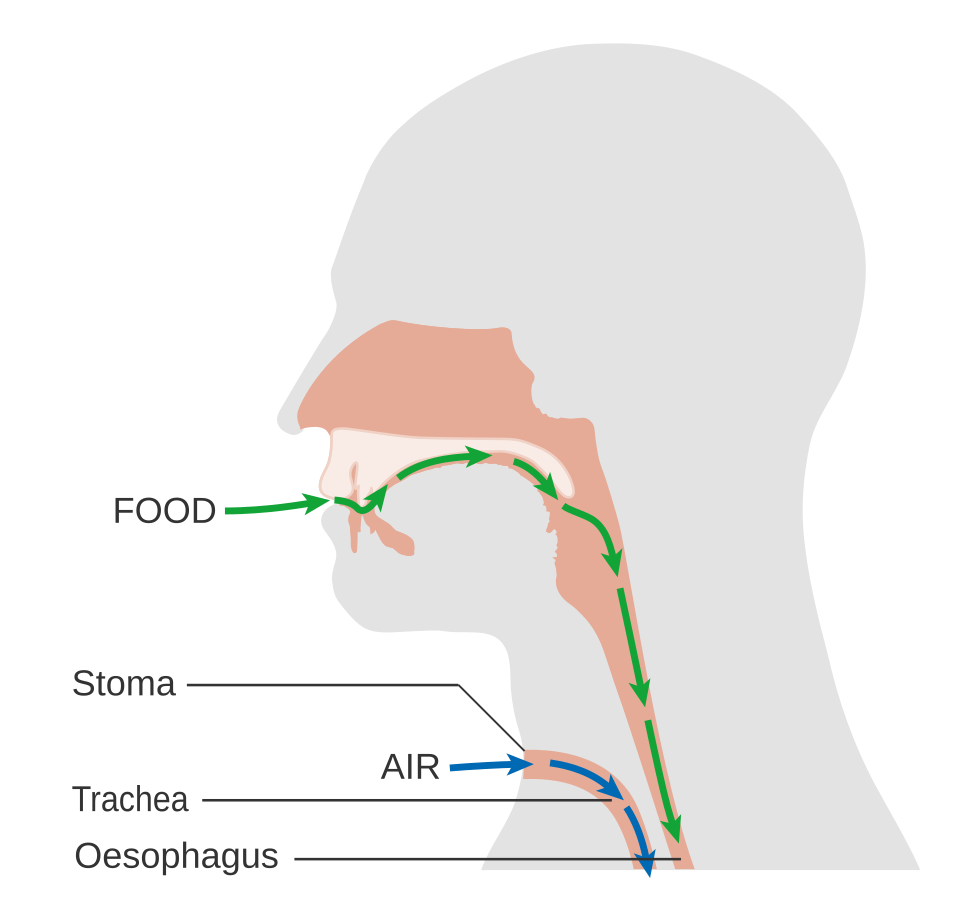

What it is
After a total laryngectomy the larynx has been removed and the trachea has been brought out as an end stoma in the front of the neck. The upper airway is no longer connected to the lungs at all. These patients are permanent neck breathers. Most have had the operation for head and neck cancer, so most are adults; this entry is written for adults only.
The practical consequence runs through everything below: oxygen, bag-valve-mask ventilation and intubation at the face achieve nothing. The National Tracheostomy Safety Project publishes a separate red algorithm for these patients for exactly this reason, paired with a red bedhead sign.
How to recognise it
- An opening in the front of the neck, usually with no tube in it. The current NTSP algorithm words this as
Not all laryngectomy stomas will have a tube in situ
— some patients do have a tube, a button or a stud, so the presence of a tube does not make it a tracheostomy. - A red NTSP bedhead sign, which reads
This patient has a LARYNGECTOMY and CANNOT be intubated or oxygenated via the mouth
. The tracheostomy sign is green. If you only remember one thing about the signs, remember that red means no upper airway. - The stoma is often covered, and the cover is easy to miss: an HME or hygroscopic stoma cover, a button, or a Buchanan bib. The NTSP manual notes that bibs
can disguise the stoma completely and the patient just appears to be wearing a scarf or cravat
. Look under the scarf. - A tracheo-oesophageal puncture (TEP) valve may be visible in the back wall of the stoma — a small one-way valve sitting between the posterior wall of the trachea and the oesophagus behind it.
- The patient may be talking to you. Speech after laryngectomy is achieved with a TEP valve, an electrolarynx held against the neck, or oesophageal speech. Speech does not mean there is an upper airway — it means air is being routed into the pharynx from below.
- Patients and carers usually know exactly what they have. Many carry an alert card; the National Association of Laryngectomee Clubs produces information for patients and staff in the UK. Ask them, or ask the person who came in with them.
What it gets confused with
Tracheostomy — the distinction that matters most, and the one the whole NTSP scheme is built around. A tracheostomy patient has a potentially patent upper airway: oxygen, face-mask ventilation and oral intubation may all still work, and the green algorithm uses them. A laryngectomy patient has none of that. The signs are colour-coded (green tracheostomy, red laryngectomy) precisely because responders cannot reliably tell the two apart by looking at the neck.
When you genuinely cannot tell, do not guess — apply oxygen to the face AND the stoma. That is the NTSP default for every neck breather in doubt, and the reasoning is asymmetric: A patient with a tracheostomy is more likely to come to harm by not having oxygen applied to the face if confusion surrounds the nature of the stoma.
Oxygen at the face costs a laryngectomy patient nothing and can be taken away once someone has confirmed what the stoma is.
What goes wrong
Blocked or partially blocked stoma
Increasing work of breathing, noisy breathing, hypoxia, distress. Secretions and crusting are the usual cause, and the patient has lost the warming and humidifying function of the nose, so secretions thicken easily.
Red flag
A patient who cannot clear the stoma themselves, or in whom a suction catheter will not pass, has an obstructed airway. Treat it as one.
The stoma cover is the obstruction
An HME or stoma cover adds resistance to breathing. The NTSP manual states this becomes clinically relevant if the patient develops an acute infection or the covers become blocked with purulent secretions
.
Red flag
This is why the algorithm has you remove the cover or button as an early step. In an unwell neck breather, the cover comes off — every time.
Lower respiratory tract disease
Pneumonia, aspiration, pulmonary oedema, pneumothorax, COPD — the patient is unwell for an ordinary reason and happens to have a stoma.
Red flag
The NTSP manual warns directly that It is easy to become fixated with the tracheostomy
. If the stoma is patent, a catheter passes and suction brings up little, the problem is below the stoma or outside the chest.
TEP valve leaking or dislodged
Coughing on drinking — classically on thin fluids — or a valve that has fallen out, leaving an open tract between oesophagus and trachea. Aspiration of food and fluid through the puncture is the hazard, not airway obstruction.
Red flag
This needs the head and neck team or speech and language therapy the same day because the tract can narrow, but it is not an airway emergency and it is not fixed by pulling the valve out.
The first ten minutes
- Call for airway expert help and put out the appropriate call. The NTSP bedhead sign lists anaesthesia, ICU, ENT, max-fax and the emergency team as the people to summon.
- Look, listen and feel at the mouth and at the laryngectomy stoma. Use waveform capnography if you have it — exhaled carbon dioxide indicates a patent or partially patent airway. A Mapleson C system may help assessment.
- Not breathing? Call the resuscitation team. CPR if there is no pulse or no signs of life.
- Breathing? Apply high-flow oxygen to the laryngectomy stoma. If there is any doubt at all about whether the patient has a laryngectomy, apply oxygen to the face as well.
- Assess stoma patency. Remove the humidification cover or button if present. Remove the inner tube if there is one — noting that some inner tubes have to be put back in to connect a breathing circuit. Do not remove a TEP prosthesis.
- Try to pass a suction catheter. If it passes, the stoma is patent: perform tracheal suction, consider partial obstruction, ventilate via the stoma if the patient is not breathing, and continue the ABCDE assessment.
- If the catheter will not pass, deflate the cuff if there is one, then look, listen and feel again at the stoma or tube, with capnography or a Mapleson C if available.
- If the patient is still not stable or improving, remove the tube from the stoma if one is present. Make sure oxygen goes back onto the stoma. Reassess. A blocked or displaced tube is removed as soon as that is established — the NTSP guideline is explicit that this is not a last resort.
- Primary emergency oxygenation is at the stoma: a paediatric face mask applied to the stoma, or an LMA applied to the stoma. Both are deliberately simple and need no special kit.
- Secondary emergency oxygenation is intubation of the stoma by someone competent to do it: a small tracheostomy tube or a 6.0 cuffed ETT, with an Aintree catheter and fibreoptic scope, bougie or airway exchange catheter considered.
- In cardiac arrest, two things work in your favour and are worth knowing in advance. The NTSP manual notes that chest compressions
will generate more significant tidal volumes owing to a reduction in dead space
, and thatOxygen insufflation alone without ventilation may be effective if ventilation proves difficult
.
Do not
should not be removed in an emergency as they should not occlude the airway and removing them will not improve acute respiratory problems. Removing it creates an open tract into the oesophagus and solves nothing.
Any stoma covers should be removed in an emergency for this reason.
will not obstruct their airway when laying flat on their back and aspiration of gastric contents is not a concern. Use the time on the stoma instead.
Who owns it
ENT / head and neck surgery, with anaesthesia and ICU for the airway itself; speech and language therapy owns the TEP valve and the patient's voice. The NTSP bedhead sign nominates anaesthesia, ICU, ENT, max-fax and the emergency team as the emergency call.
When you phone, lead with the word laryngectomy and say whether the stoma is patent, whether a suction catheter passes, whether there is a tube in the stoma and whether there is a TEP valve. Those four facts determine what they bring.
Who to call
The team and the criteria are national. The phone number is local, and this tool does not know it. Find it once, now, and write it on the department's own card — that is the part no website can do for you.
- Say the device name first
- Open with laryngectomy, LVAD, shunt — the single word changes who comes and what they bring. Do not bury it in the history.
- Say what you have already established
- Whether the device is patent, whether it has been removed or disturbed, and what you have already tried. The specialist is deciding whether to walk or run.
- Ask who owns it out of hours
- Device ownership and the on-call route often differ from the implanting specialty, and it is frequently a regional centre rather than your own hospital.
- The patient's own team is a resource, not an afterthought
- Named nurse specialists, home-care companies and device helplines answer questions nobody else can, and the patient usually has the number.
When the device is not the problem
A patient with a device gets pneumonia, sepsis, pulmonary oedema and myocardial infarction at the same rate as everybody else. The device is the most visible thing about them and it attracts the whole assessment.
- The NTSP says it out loud
- The project's own manual warns that
patients with tracheostomies can become unwell with all the problems that other patients get too. It is easy to become fixated with the tracheostomy.
The same sentence applies to every device in this tool. - Clear the device, then leave it
- Establish that the device is doing its job — the stoma is patent, the line draws back, the pump is running — and then assess the patient as you would anyone else.
- The anchoring runs both ways
- The opposite error is treating a device complication as a medical illness: a blocked gastrostomy read as vomiting, a baclofen pump failure read as sepsis.
- NTSP manual — Red flags · read in full
What the patient will be carrying
Many laryngectomees carry an alert card identifying them as a neck breather. The red NTSP bedhead sign, where one has been used, records the date of the operation, the tube size if there is a tube, and the emergency call list. Patient and carer information in the UK comes from the National Association of Laryngectomee Clubs.
Scope of this page
This page covers recognising a laryngectomy stoma and the first minutes of an airway emergency in one. It follows the NTSP red algorithm as far as the two emergency oxygenation steps and stops there: intubation of the stoma, fibreoptic rescue and anything involving the puncture itself belong to the airway expert and the head and neck team, and the algorithm's own design is that a first responder summons them at step one. It does not cover routine stoma care, TEP valve changes, or laryngectomy in children, which is rare enough that no part of this page should be applied to a child.
Remove humidification cover or buttonand
Not all laryngectomy stomas will have a tube in situ. An older text-layer copy (review date 1/1/20, and a 1/4/14 copy inside the manual) says
Remove stoma coverand
Most laryngectomy stomas will NOT have a tube in situ. This page follows the current version and the older wording is not used. The narrative statements quoted here — flat positioning, dead space in CPR, TEP valves, stoma covers — come from the manual chapters, which have no newer edition.
Sources
- NTSP adult red laryngectomy emergency algorithm (review date 1/1/27) · read from the rendered figure
- NTSP red laryngectomy bedhead sign · read in full
- NTSP manual — Emergency laryngectomy management; Emergency care; Red flags · read in full
- NTSP manual — Speech after total laryngectomy; Laryngectomy humidification · read in full
- McGrath BA, Bates L, Atkinson D, Moore JA; National Tracheostomy Safety Project. Multidisciplinary guidelines for the management of tracheostomy and laryngectomy airway emergencies. Anaesthesia 2012;67(9):1025-41 · PMID 22731935 · abstract read
- NTSP adult green tracheostomy algorithm (review date 1/1/27) — read to verify the contrast drawn above · read from the rendered figure