Intraosseous access (already sited)
Emergency access drilled into bone, often sited prehospital. It works for everything IV - but it comes out within 24 hours and compartment syndrome is the thing to watch.
Also called: IO, intraosseous, IO needle, EZ-IO, intraosseous access, humeral IO, tibial IO
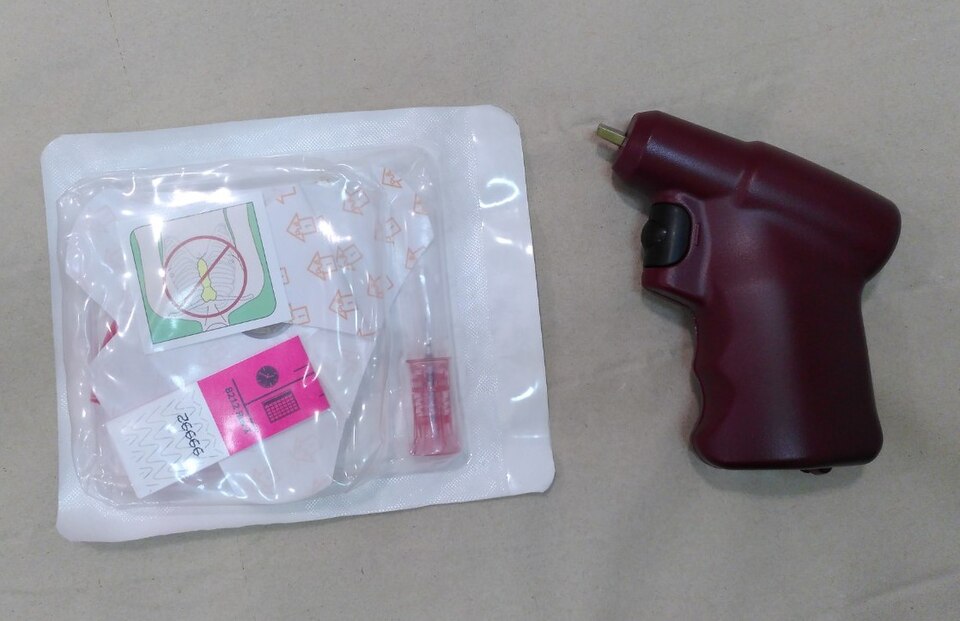

What it is
Intraosseous (IO) access is a needle placed into the marrow of a bone - commonly the proximal tibia or proximal humerus - to give fluids, drugs and blood when a vein cannot be obtained quickly. It is a resuscitation bridge, frequently placed by prehospital crews, and this entry is about the IO that is already in when the patient reaches you.
Anything that can go into a vein can go into the marrow, and it reaches the central circulation in seconds. But it is temporary: a systematic review concludes the use of IO access should be limited to a few hours until IV access is achieved without exceeding 24 hours
, and the manufacturer instructions state the catheter must be removed within 24 hours from the time of insertion
. IO is a mainstay of paediatric as well as adult resuscitation.
How to recognise it
- A short, chunky needle hub taped into the proximal tibia (just below and medial to the knee) or proximal humerus (shoulder), usually with a luer connector and a flush already attached.
- A patient who has been resuscitated prehospital or peri-arrest, where rapid access was needed.
- It runs fluids and drugs; aspirated marrow can be sent for some laboratory tests (e.g. glucose, group and save) - check local lab acceptance.
What goes wrong
Extravasation and compartment syndrome
Swelling around the insertion site, resistance to flushing, or a tense, swollen limb - the needle has displaced or the bone is breached and fluid is leaking into the tissues.
Red flag
The review is explicit: Compartment syndrome due to extravasation of fluid is the most common complication.
Check the limb before and during use; if there is swelling or poor flow, stop infusing through it, remove the needle, and assess for compartment syndrome - get urgent orthopaedic/surgical review if it is suspected.
It is in a bone it should not be, or will not run
Poor flow, pain, or a site over a fractured bone or a previous IO attempt.
Red flag
A fracture defeats the access: A fractured bone leads directly to extravasation of fluids and infused medications and thus to complete inefficacy of IO access.
If it will not run or the bone is fractured, it is not usable - get alternative access.
Pain on infusion in a conscious patient
Severe pain when fluid or drugs are pushed, in an awake patient.
Red flag
IO infusion is painful when conscious; slow preservative-free, epinephrine-free lidocaine through the needle before flushing (per protocol and dose) reduces it, though it does not abolish it. Do not withhold a needed drug, but treat the pain.
The first ten minutes
- Confirm it works before you rely on it: it should flush, and ideally aspirate marrow. Check the limb for swelling. If it will not flush or the limb is swelling, assume extravasation - stop and resite access elsewhere.
- Use it for what you need - fluids, drugs, blood all go IO, and it reaches the central circulation within seconds. For a humeral IO, keep the arm adducted across the body so the needle does not dislodge.
- In a conscious patient, give lidocaine through the IO before flushing to control the pain of infusion (preservative-free, epinephrine-free, per local protocol and dose).
- Get definitive IV (or central) access and remove the IO as soon as practicable - the needle comes out within 24 hours of insertion, so note the time it went in.
- Check and document the insertion time and site, and hand over the deadline to the receiving team.
Do not
Who owns it
Whoever is running the resuscitation - the ED/critical care team - owns the IO while it is in. There is no separate device service; the task is to use it, get definitive access, and remove it within the time limit. Hand over the insertion time and site.
Who to call
The team and the criteria are national. The phone number is local, and this tool does not know it. Find it once, now, and write it on the department's own card — that is the part no website can do for you.
- Say the device name first
- Open with laryngectomy, LVAD, shunt — the single word changes who comes and what they bring. Do not bury it in the history.
- Say what you have already established
- Whether the device is patent, whether it has been removed or disturbed, and what you have already tried. The specialist is deciding whether to walk or run.
- Ask who owns it out of hours
- Device ownership and the on-call route often differ from the implanting specialty, and it is frequently a regional centre rather than your own hospital.
- The patient's own team is a resource, not an afterthought
- Named nurse specialists, home-care companies and device helplines answer questions nobody else can, and the patient usually has the number.
When the device is not the problem
A patient with a device gets pneumonia, sepsis, pulmonary oedema and myocardial infarction at the same rate as everybody else. The device is the most visible thing about them and it attracts the whole assessment.
- The NTSP says it out loud
- The project's own manual warns that
patients with tracheostomies can become unwell with all the problems that other patients get too. It is easy to become fixated with the tracheostomy.
The same sentence applies to every device in this tool. - Clear the device, then leave it
- Establish that the device is doing its job — the stoma is patent, the line draws back, the pump is running — and then assess the patient as you would anyone else.
- The anchoring runs both ways
- The opposite error is treating a device complication as a medical illness: a blocked gastrostomy read as vomiting, a baclofen pump failure read as sepsis.
- NTSP manual — Red flags · read in full
What the patient will be carrying
There is usually no patient card - an IO is an emergency, in-the-moment device. The prehospital record should state the insertion time and site; get it at handover so the removal deadline is known.
Scope of this page
This page covers the intraosseous needle that is already in place: confirm it works, use it, control infusion pain, watch for extravasation/compartment syndrome, and remove it within 24 hours. It does not teach IO insertion technique or site selection, which are covered in resuscitation training and the ED Procedures tool. There is no single UK national guideline for IO device dwell and care, so this page draws on a systematic review (which is of adults only) and the manufacturer instructions. IO is equally a standard of paediatric resuscitation (APLS/RCUK), and the manufacturer instructions cover paediatric lidocaine dosing - paediatric specifics follow those sources, not the adult review.
Sources
- Petitpas F, Guenezan J, Vendeuvre T, et al. Use of intra-osseous access in adults: a systematic review. Crit Care 2016;20:102 · PMID 27075364 · read in full
- Teleflex / Arrow. EZ-IO Intraosseous Vascular Access System - Care & Maintenance (document MC-000806). Manufacturer instructions for use · read in full